
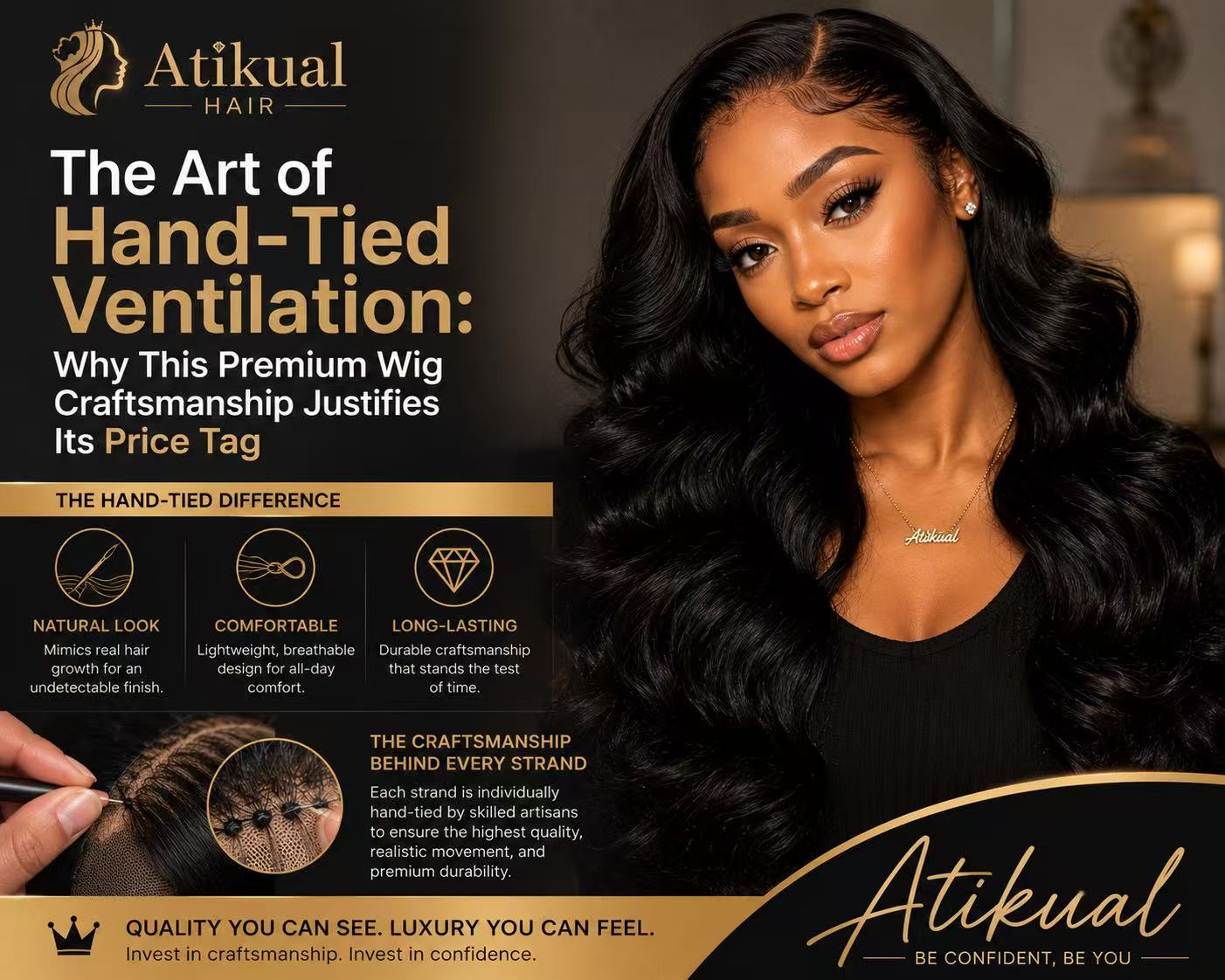
The Art of Hand-Tied Ventilation: Why This Premium Wig Craftsmanship Justifies Its Price Tag
When browsing for high-quality human hair wigs, you've likely encountered the term "hand-tied ventilation" or "injection needle technique" (also known as 递针工艺 in Chinese manufacturing) — often associated with premium pricing and superior naturalness. But what exactly is this intricate process, and why does it command a higher cost compared to machine-made alternatives? This comprehensive guide will demystify the hand-tied ventilation technique, explain its unique benefits, and break down the factors that make it a worthwhile investment for discerning wig wearers.
What Is Hand-Tied Ventilation (递针工艺)?
Core Definition
Hand-tied ventilation, or 递针工艺 (dì zhēn gōng yì), is an artisanal wig-making technique where individual hair strands are manually knotted and "injected" through a double-layered cap system to create the illusion of natural hair growth directly from the scalp. Unlike machine-sewn wefted wigs that use horizontal tracks of hair, hand-tied ventilation involves a meticulous, labor-intensive process that mimics the biological structure of human hair follicles.
The Two-Layered Construction Method
The 递针工艺 process follows a precise sequence:
Base Layer Preparation: Artisans start by creating a foundational net layer (typically a fine Swiss lace or mesh material) that forms the base of the wig cap.
Initial Knotting: Each hair strand is individually hand-tied onto this base layer using specialized ventilating needles — often using single knots for natural hairlines and double knots for areas requiring more durability.
The "Injection" Step: After securing the hair to the base layer, the artisan uses a fine needle to "inject" or "hand-tie" the root ends through a second, ultra-thin simulation scalp mesh (often silk or transparent lace). This second layer acts as a "scalp" that hides the knots, creating the illusion of hair growing directly from the skin.
Knot Bleaching (Optional): For an even more natural look, the tiny knots at the base of the hair can be bleached to match the scalp tone, eliminating visible dark dots that might otherwise give away the wig's construction.
Types of Hand-Tied Ventilation
Not all hand-tied techniques are identical. The two primary methods include:
Single Knot Ventilation One hair strand per knot, creating tiny, nearly invisible attachment points Front hairlines, parting areas, and high-visibility zones where naturalness is paramount
Double Knot Ventilation Two strands tied together for extra strength and durability Crown and back areas that require more resilience against styling and daily wear
Needle-Punched (Triple Layer) Ventilation Advanced three-layer system (scalp simulation + 蚕丝网 + base net) for ultimate realism Premium full-lace wigs and custom hairpieces where complete naturalness is essential
How Hand-Tied Ventilation Differs From Machine-Made Wigs
To appreciate why hand-tied wigs cost more, it's essential to understand the fundamental differences between this artisanal process and mass-produced machine-made alternatives.
Machine-Made Wig Construction
Machine-made wigs rely on wefting technology, where hair is sewn into horizontal tracks (wefts) using industrial sewing machines. This process:
Is fast and efficient, producing wigs in hours rather than days
Creates a dense, structured cap with visible seams and less natural movement
Limits styling versatility, often restricting parting to pre-determined areas
Results in a heavier, less breathable cap that can feel bulky on the scalp
Hand-Tied Ventilation Advantages
Hand-tied wigs, by contrast, offer a fundamentally different wearing experience:
Unmatched Natural Movement: Each hair strand moves independently, mimicking the way biological hair shifts with movement — no stiff, "helmet-like" feel
Complete Styling Freedom: Wearers can part their hair anywhere on the cap, create updos, ponytails, and deep side parts without revealing the wig's construction
Lightweight Comfort: The double-layer lace construction eliminates heavy wefts, making hand-tied wigs significantly lighter and more breathable — ideal for all-day wear and sensitive scalps
Invisible Scalp Illusion: The second mesh layer and bleached knots create the appearance of hair growing directly from your skin, even under close inspection
Customizable Density: Artisans can vary hair density throughout the cap, creating natural-looking "thinning" at the temples and fuller coverage where needed — just like real hair
Why Hand-Tied Ventilation Costs More: The 5 Key Factors
The premium price of hand-tied wigs isn't arbitrary — it reflects the true cost of creating a superior product through skilled craftsmanship and high-quality materials.
1. Labor-Intensive Production Process
This is the single most significant cost driver. A full hand-tied wig requires 40-80 hours of meticulous work from a highly skilled artisan, compared to justa few hours for a machine-made alternative.
Consider these staggering statistics:
A standard 14-inch hand-tied wig requires approximately 20,000-30,000 individual knots
Master artisans can only complete about 1,000 knots per hour — even with years of training
The "injection" step alone adds 30-50% more labor time compared to basic hand-knotting
In 许昌 (Xuchang), China — the global hub of human hair wig production — experienced ventilation artisans command premium wages due to their specialized skills, further driving up production costs.
2. Specialized Artisan Expertise
Hand-tied ventilation isn't a skill that can be learned overnight. Mastering this technique requires:
2-3 years of formal training to achieve consistent knot quality and speed
Deep understanding of hair growth patterns, density distribution, and scalp simulation
Proficiency in multiple knotting techniques (single, double, loop) for different cap areas
Meticulous attention to detail to ensure uniform hair direction and natural flow
The scarcity of truly skilled ventilation artisans — combined with the physical demands of the work (which can cause hand fatigue and repetitive strain injuries) — further increases labor costs.
3. Premium Materials Requirement
Hand-tied wigs demand higher-grade materials at every stage:
Cap Materials Ultra-fine Swiss lace, medical-grade mesh, or silk simulation scalp — must be thin enough to be breathable yet durable enough to hold individual knots 3-5x more expensive than standard wig cap materials
Hair Quality Only the highest-grade Remy human hair (cuticle-aligned) — lower-quality hair would shed excessively or lack natural movement Premium hair costs 2-4x more than non-Remy alternatives
Knotting Thread Medical-grade, hypoallergenic thread that won't irritate scalps or degrade over time Specialty thread costs 50-100% more than standard sewing thread
4. Quality Control & Artisanal Oversight
Every hand-tied wig undergoes rigorous quality control:
Individual inspection of every knot to ensure secure attachment and consistent size
Multiple fitting tests to verify natural movement and scalp simulation 效果
Detailed examination under different lighting conditions to ensure invisibility of knots
This level of scrutiny — often performed by master artisans rather than automated systems — adds significant time and cost to the production process.
5. Lower Production Volume & Exclusivity
Hand-tied wigs cannot be mass-produced at the same scale as machine-made alternatives. A single workshop might produce only 5-10 hand-tied wigs per week, compared to hundreds of machine-made units.
This limited supply Increases per-unit overhead costs
Creates exclusivity that justifies premium pricing
Ensures each piece receives individual attention from start to finish
The Value Proposition: Is Hand-Tied Ventilation Worth the Investment?
For many wig wearers, the higher cost of hand-tied ventilation is more than justified by the long-term value and transformative wearing experience it provides.
Consider this practical comparison (based on 2026 market prices):
Machine-Made Wig $150-$300 3-6 months $1.67-$3.33
Hand-Tied Wig $800-$2,000 1-2 years $1.10-$2.74
When calculated over time, hand-tied wigs often provide better value despite the higher upfront cost — especially for daily wearers.
Intangible Benefits That Justify the Price
Beyond the financial calculation, hand-tied ventilation delivers:
Confidence & Peace of Mind: The natural appearance eliminates worries about "wig detection," allowing wearers to style their hair freely without self-consciousness
Scalp Health: The breathable, lightweight construction reduces sweat buildup and irritation — a critical benefit for those with sensitive scalps or medical-related hair loss
Styling Versatility: From sleek ponytails to loose waves and dramatic parts, hand-tied wigs offer the same styling freedom as natural hair
Emotional Well-Being: For many individuals experiencing hair loss, the ability to look and feel "like themselves" again is priceless
How to Identify Authentic Hand-Tied Ventilation
With the growing popularity of hand-tied wigs, some manufacturers use misleading marketing terms. Here's how to verify genuine craftsmanship:
Check the Cap Construction: Authentic hand-tied wigs have a thin, mesh-like cap with no visible wefts or horizontal seams
Test Styling Flexibility: Can you part the hair in any direction? Does it maintain a natural appearance when pulled back?
Examine the Scalp Simulation: Look closely at the parting area — you should see the illusion of individual hair follicles growing from a realistic scalp texture
Verify Knot Quality: Under magnification, you should see tiny, uniform knots that are either bleached or hidden beneath the simulation layer
Ask About Production Time: Genuine hand-tied wigs typically take 2-4 weeks to produce, while machine-made alternatives are available immediately
Conclusion: Investing in Artistry & Naturalness
Hand-tied ventilation (递针工艺) represents the pinnacle of wig craftsmanship — a harmonious blend of artistry, technical skill, and premium materials that creates an unparalleled natural hair experience. While the price tag is higher than machine-made alternatives, the investment buys more than just a wig: it purchases confidence, comfort, and the freedom to express your personal style without compromise.
For discerning buyers who value authenticity, longevity, and the ultimate "no-wig" look, hand-tied ventilation isn't just a luxury — it's the gold standard of wig construction that delivers lasting value far beyond the initial cost.
FAQ: Common Questions About Hand-Tied Ventilation
Q: How long does a hand-tied wig last?
A: With proper care, a high-quality hand-tied wig can last 1-2 years of regular wear — significantly longer than machine-made alternatives.
Q: Can I style a hand-tied wig with heat tools?
A: Yes! Since most hand-tied wigs use 100% Remy human hair, they can be styled with heat tools just like natural hair (always use heat protectant).
Q: Are hand-tied wigs suitable for sensitive scalps?
A: Absolutely. The lightweight, breathable construction and hypoallergenic materials make hand-tied wigs an excellent choice for those with scalp sensitivities.
Q: How do I care for a hand-tied wig?
A: Gently wash with sulfate-free shampoo, avoid rubbing the cap, air-dry on a wig stand, and store properly when not in use to preserve the delicate knotting.

%20%E2%80%94%20often%20asso...)
Leave a comment
This site is protected by hCaptcha and the hCaptcha Privacy Policy and Terms of Service apply.